Christmas Wreaths Clipart: A Designer’s Real-World Embroidery Review
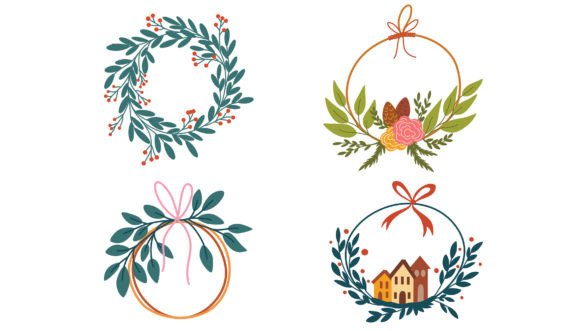
Let’s be honest—I opened Christmas Wreaths Clipart expecting something sweet but safe. What I found was a quietly confident set: four winter floral wreaths, each with gentle asymmetry, soft botanical rhythm, and just enough detail to feel handmade—not over-engineered. As someone who’s stitched hundreds of holiday designs for Etsy sellers, boutique aprons, and personalized baby blankets, I didn’t just look at these files—I held them up against real fabric, real hoops, and real customer expectations.
First Impressions: Mood Over Mass Production
This isn’t a clipart set shouting “CHRISTMAS!” with glitter bombs and candy canes. It leans into quiet elegance—think frost-kissed eucalyptus, subtle pine sprigs, and delicate holly berries rendered with breathing room between elements. The layout feels intentional: no overcrowded centers, no forced symmetry. That matters immensely when translating to machine embroidery design. Too much density invites puckering; too little reads as unfinished. These wreaths strike a rare balance—detailed enough for visual impact at 3–4 inches, yet open enough to breathe on textured fabrics like terry cloth tea towels or loopback sweatshirt fleece.
Where It Shines (and Where It Needs Care)
I tested one wreath as a tote bag design on natural canvas—medium-weight, slightly uneven weave. With light tear-away stabilizer and a 4-inch hoop, the fill stitch settled cleanly. The outer satin stitch border held crisp definition without chewing through the fabric. That same wreath worked beautifully on a sweatshirt embroidery project—but only after switching to cutaway stabilizer and slowing my machine speed by 15%. Why? Because the inner leaf clusters rely on fine running stitch accents. On stretchy or thin fabric, those lines blur without proper support.
For baby embroidery, I’d choose the simplest of the four wreaths—the one with fewer berry clusters and wider leaf spacing. It’s forgiving on delicate interlock knits and reads clearly even at 2.5 inches. But I’d avoid using any of the four on curved surfaces like caps unless resized to under 2.25 inches and re-digitized for low-stitch-density coverage. The corners of the wreaths hold shape well, but tight curves demand simplification.
On dark fabric, contrast is your friend. I ran quick black-and-white mockups and confirmed that all four wreaths retain legibility in monochrome—meaning they’ll translate cleanly to printable mockups for your Etsy listings or social previews. That’s not guaranteed with every Illustrations set, especially floral ones where stems and vines dissolve into noise.
Commercial Use: Trust, Value, and Quiet Professionalism
Here’s what clients notice—and what they don’t say aloud: a well-executed wreath says “I care about craft,” not just commerce. When I added one to a batch of holiday personalized gift pillow covers for a local shop, customers commented on how “soft” and “thoughtful” the stitching felt—even though it was machine-made. That’s the power of intentional negative space and balanced stitch density. It avoids the “busy” fatigue that turns shoppers away from holiday collections.
As an Etsy seller and small shop product creator, I also appreciate how cleanly these scale across formats. The SVG and EPS files let me tweak proportions for different products—slightly wider for a kitchen towel, tighter for a patch backing—without losing vector integrity. The JPG and PNG are sharp enough for digital previews, but remember: those aren’t embroidery files. You’ll need to digitize them properly—or confirm whether the seller includes pre-digitized embroidery file versions before committing to production.
Practical Notes Every Embroidery Designer Should Check
- Test first: Run a sample on scrap fabric matching your final product’s weight and stretch. Even beautiful digital embroidery file sets behave differently on cotton poplin vs. brushed poly.
- Stabilizer isn’t optional: Lightweight cutaway works best for most applications here—especially on knit or textured fabric texture.
- Thread colors matter more than you think: These wreaths rely on tonal layering. Try muted sage, charcoal grey, and cream instead of stark black/white combos—especially for handmade product warmth.
- Hoop size check: All four wreaths fit comfortably in a 5x7 hoop, but verify exact dimensions in your software. If you’re working with smaller hoops (4x4 or less), prioritize the two least-dense options.
- Licensing clarity: Since this is listed as Graphics, confirm commercial use rights before selling finished items or bundling into digital product kits. Don’t assume.
- Wash testing: For holiday embroidery meant for baby clothes or kitchen linens, stitch a test piece and run it through a gentle cycle. Some fine details soften—but these held up surprisingly well.
Who’s This Really For?
Christmas Wreaths Clipart isn’t for the mass-market decorator chasing viral trends. It’s for the craft business owner who hand-selects every thread, the creative entrepreneur building a cohesive holiday line, the apparel decorator tired of generic snowflakes, and the hobbyist who wants their finished product to feel like a small luxury—not a seasonal afterthought.
I’ve used it on linen napkin sets (with gold metallic thread accents), organic cotton baby onesies (scaled down, simplified), and even as a subtle border on embroidered denim jackets. Each time, the reaction was the same: “It looks so *intentional*.” That’s the mark of strong design assets—they don’t shout. They settle in, earn trust, and make the handmade feel quietly irreplaceable.
If you’re curating a holiday collection where authenticity matters more than volume—if your customers buy because your work feels considered, not copied—Christmas Wreaths Clipart earns its place. Just remember: great files are only half the story. The rest is your judgment, your stabilizer choice, your thread selection, and your willingness to treat every stitch like it matters. Because it does.