Human Bone Anatomy SVG Set
A Clean, Clinical Vibe—Not Just for Doctors
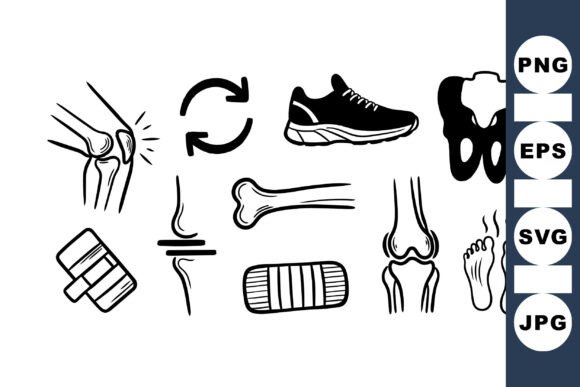
First impression? This isn’t a cartoon skeleton or Halloween gimmick. The Human Bone Anatomy SVG Set lands with quiet precision: sharp linework, balanced negative space, and intentional minimalism. It’s medical—but approachable. Think anatomy chart meets modern craft aesthetic. The inclusion of subtle contextual elements—a sneaker, cycling arrows, pain signs on feet, even bandages—adds narrative without clutter. That matters when you’re stitching for real people, not textbooks.
Where It Shines in Real Embroidery Projects
I tested the Human Bone Anatomy SVG Set as the centerpiece for a custom embroidered tote bag for a local physical therapy clinic’s staff appreciation day. The clean linear style translated beautifully into satin-stitched outlines over medium-weight canvas—no fill stitch needed, just crisp running and satin work tracing bone contours. It felt professional, not clinical; thoughtful, not cold.
It also worked well scaled down (3.5” wide) on a baby onesie—just the femur + ankle joint motif—paired with soft gray thread on ivory cotton. Parents appreciated the quiet nod to movement and care, not morbidity. For Etsy sellers, this set is gold for niche wellness shops: yoga studios, sports rehab brands, or holistic PTs wanting embroidered aprons, tea towels, or pillow covers that speak competence *and* warmth.
On sweatshirts? Yes—but choose placement wisely. A single clavicle + shoulder joint near the left chest reads elegant and intentional. Avoid cramming all elements onto one garment. The set’s strength is modularity: pull one bone, one joint, or one symbolic element (like the cycling arrows) rather than forcing the full composition.
Where Caution Is Built Into the Lines
This isn’t a “throw-it-on-and-stitch” design. Its minimalism demands respect for fabric behavior and embroidery physics:
- Small hoop sizes: The foot-with-pain-sign motif has fine directional lines—under 2.5” it risks losing legibility. Test on scrap first.
- Textured or stretchy fabrics: On ribbed knits or slubbed linen, those thin linear joints can blur or distort. Use cutaway stabilizer and reduce stitch speed.
- Dark fabric: Since it’s black-and-white vector art, contrast relies entirely on thread choice. White thread on navy works—but avoid light gray thread on charcoal. Always mock up digitally in both light/dark modes before stitching.
- Curved surfaces: Caps or curved pillow edges exaggerate line thinning. Simplify to one core element (e.g., just the pelvis outline) rather than layered bones.
- Frequent washing: The design’s low stitch density helps—but avoid dense fill areas where they don’t exist. This set leans on outlines, which hold up better over time than heavy satin coverage.
What It Adds to Your Finished Product—Beyond Aesthetics
Embroidery isn’t just decoration—it’s credibility. When a boutique sells an apron with the Human Bone Anatomy SVG Set stitched on the pocket, customers read attention to detail, thematic intention, and quiet expertise. That builds trust faster than generic florals.
For handmade product listings, it elevates perceived value: a $28 kitchen towel feels like a curated wellness tool, not just cotton. And for personalized gifts—say, a cycling-themed birthday gift for a PT—the sneaker + cycling arrow combo adds narrative resonance no stock font could match.
It also supports brand consistency. If your craft business centers on mindful movement, anatomy-adjacent motifs unify your digital embroidery file library, printable mockups, and physical products—without repeating the same icon across every listing.
Practical Designer Notes Before You Stitch
Before committing to a client project or bulk production:
- Run a test on scrap fabric matching your final substrate—especially if using textured, dark, or lightweight cloth.
- Check thread color contrast in natural light *and* under store lighting. What reads clearly on screen may vanish on fabric.
- Review stitch density visually—not just numerically. Thin lines should stay distinct, not merge into fuzz.
- Confirm your intended hoop size accommodates the largest single motif you plan to use (e.g., full spine layout vs. isolated tibia).
- Zoom in on corners and intersections: do joints align cleanly? Are pain-sign arrows sharp or pixelated at embroidery scale?
- Test black-and-white mockups side-by-side—this set lives in monochrome, so its impact must hold without color crutches.
- Verify stabilizer type: tear-away for stable wovens, cutaway for knits or lightweight blends.
- Double-check licensing terms in the ZIP folder—especially if selling finished embroidered items or bundling the SVG as part of a commercial embroidery file pack.
Final Thought: A Design That Respects the Maker—and the Wearer
The Human Bone Anatomy SVG Set doesn’t shout. It observes, clarifies, and connects. It’s ideal for crafters who value subtlety over spectacle, and for small businesses building identity through intelligent design—not trends. Whether you’re embroidering a therapist’s tote, a cyclist’s cap, or a new parent’s nursery pillow, this set gives you room to mean something specific. Not “medical,” but *human*. Not “anatomy,” but *movement*, *care*, *resilience*.
That’s rare in the Crafts category—and exactly why it belongs in your Graphics toolkit.